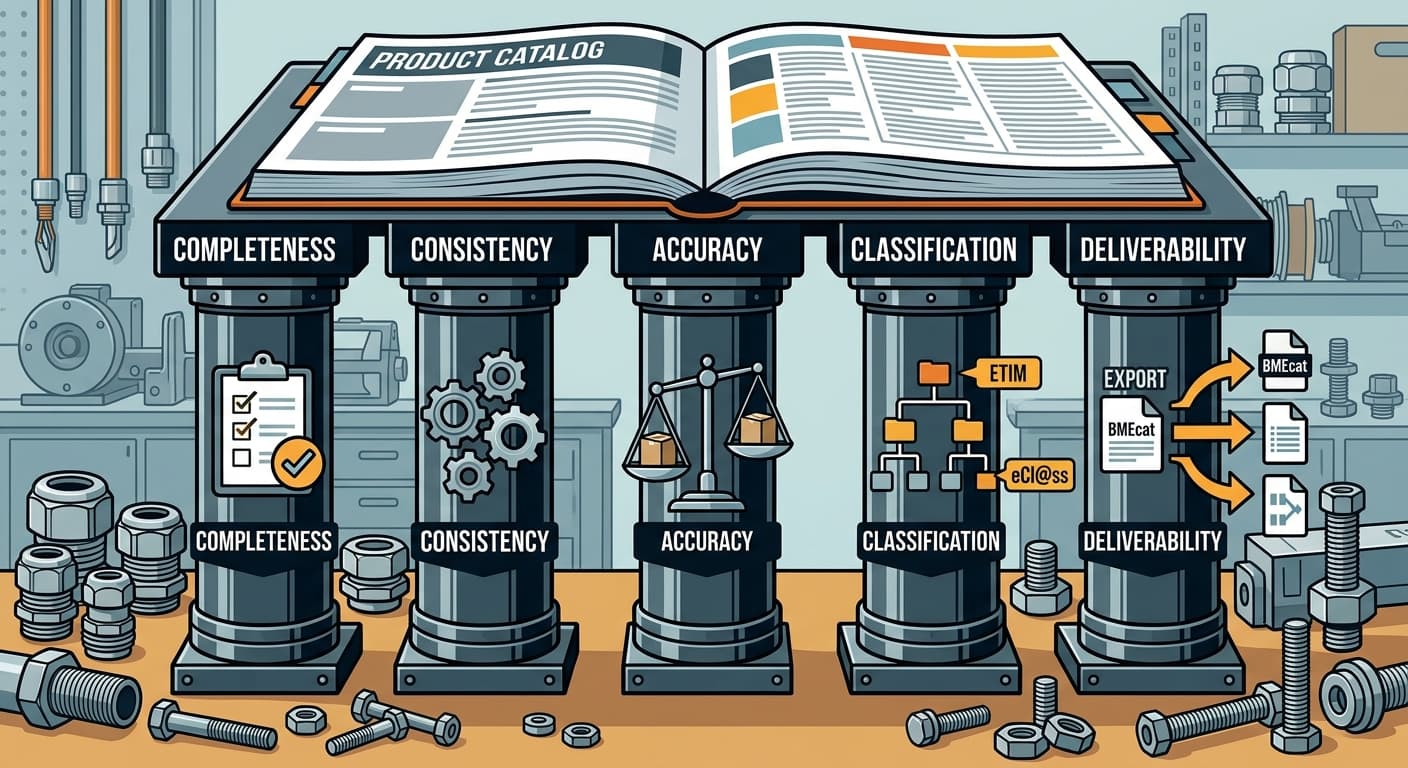
Product Data Quality Checklist for Industrial Suppliers
In the fast-paced world of industrial supply, where precision engineering meets global marketplaces, poor product data can lead to lost sales, compliance issues, and frustrated customers. Imagine a buyer searching for a specific cable gland only to find inconsistent specs or missing certifications—deal breaker. That's why a robust product data quality checklist is essential for industrial suppliers. This practical guide provides a scannable, actionable framework to audit your Product Information Management (PIM) system. Use it to identify gaps, standardize your data, and elevate your offerings to meet B2B expectations like ETIM classifications and BMEcat exports.
Whether you're managing thousands of SKUs for fittings, fasteners, or automation components, this product data quality checklist covers the five pillars: Completeness, Consistency, Accuracy, Classification, and Deliverability. Print it out, go through each item, and transform your data from a liability into a competitive advantage. Let's dive in.
1. Completeness
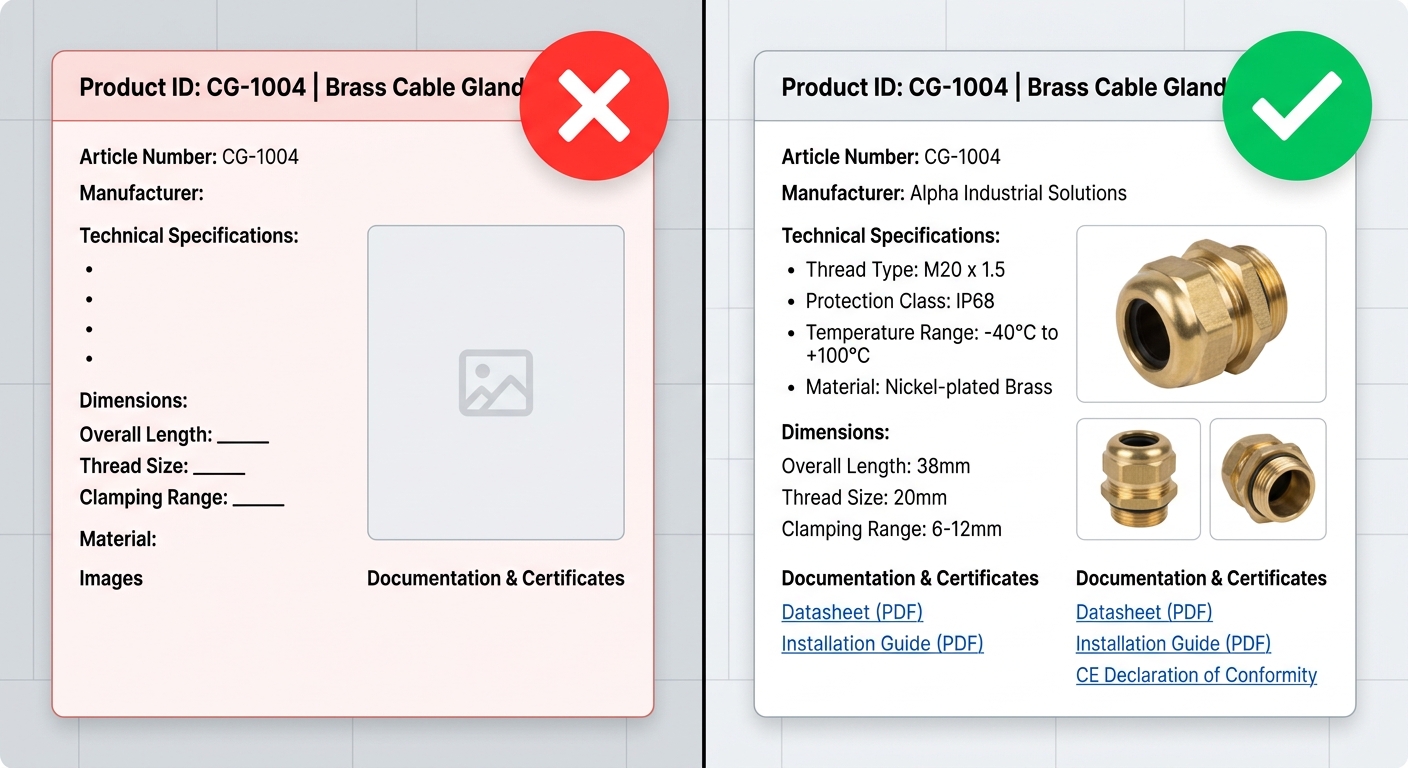
Completeness ensures every product record has the essential details buyers need to make informed decisions. For industrial suppliers, incomplete data often stems from legacy spreadsheets or siloed ERP systems, leading to abandoned carts on platforms like IndustryMall or RS Components. A thorough product data quality checklist starts here: verify that no critical fields are blank, especially for high-volume lines like electrical components or mechanical parts.
Start by exporting a sample of 100 products and systematically check each item below. Aim for 95%+ completeness across your catalog.
-
Every product has a unique identifier (article number, EAN/GTIN)
No duplicates or orphans. In industries like manufacturing, a GTIN-14 for logistics or a custom article number ensures traceability from factory floor to end-user. -
All mandatory attributes for your industry are filled (dimensions, materials, ratings)
For example, include length, diameter, material (e.g., stainless steel AISI 316), IP rating, and load capacity. Missing these? Buyers can't compare or specify accurately. -
Product descriptions exist (not just article numbers)
Craft short, SEO-friendly titles (e.g., "M20 Cable Gland, Polyamide, IP68, 8-12mm") and detailed descriptions highlighting features, benefits, and applications like hazardous environments. -
Images available for at least your top product lines
High-res photos from multiple angles, plus lifestyle shots in assemblies. Prioritize A-items (80/20 rule) to boost conversion rates by 30-50%. -
Technical documents (datasheets, certificates) are linked
PDFs for RoHS compliance, UL listings, or 3D models. Direct links reduce support tickets and build trust.
By addressing completeness first, you'll plug the biggest holes in your product data quality checklist, making your catalog more shoppable and compliant with standards like UNSPSC.
2. Consistency
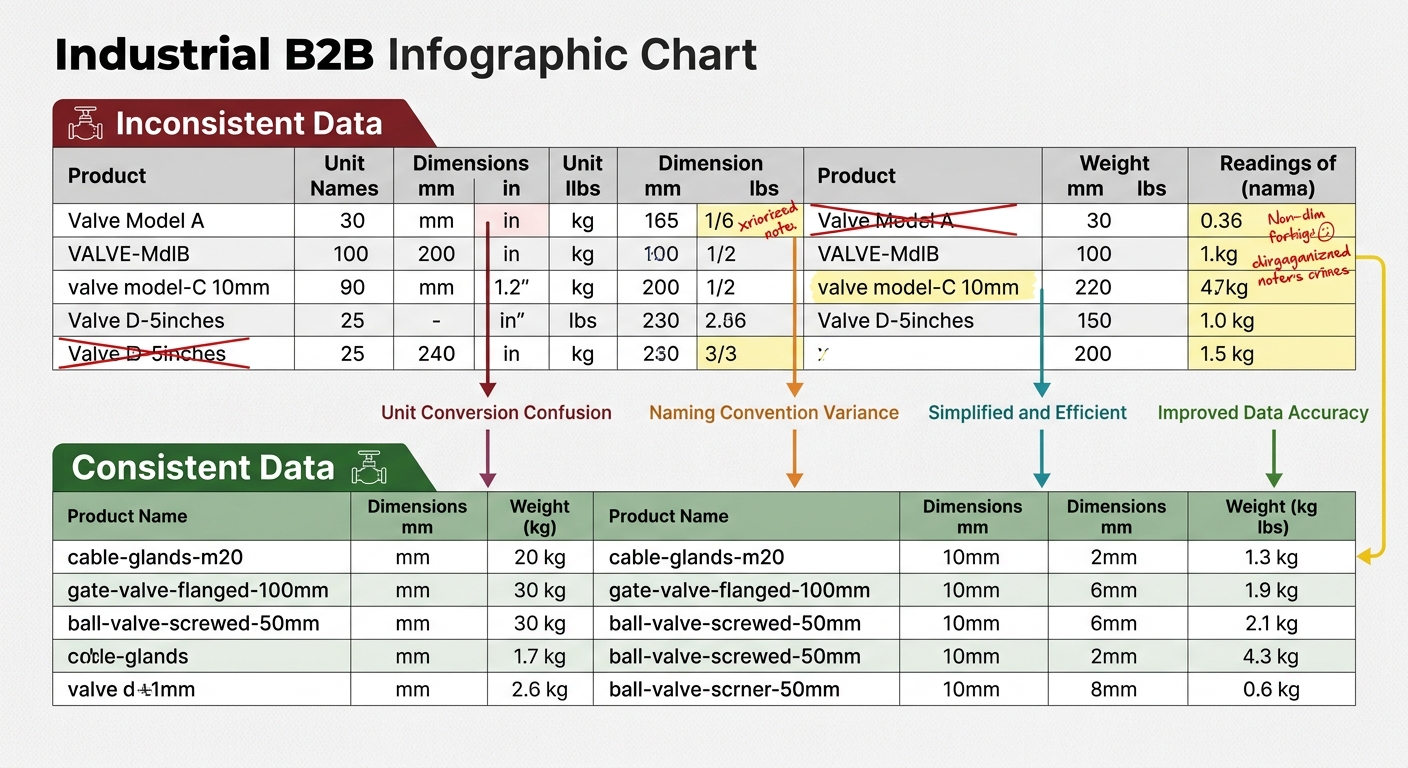 (this image is also a bit inconsistent with the double weight column, but we figured it still helps to illustrate the point)
Inconsistent data is the silent killer of B2B trust—think a valve listed as "PN 16" in one export and "16 bar" in another. Standardization across your entire catalog prevents errors in customer integrations and ERP syncing. This section of the product data quality checklist focuses on uniform formats, which is crucial for industrial suppliers dealing with multinational clients expecting metric consistency.
Run a data validation script or PIM audit to flag variances. Consistency isn't just cosmetic; it's foundational for automation and AI-driven enrichment.
-
Units are standardized (all dimensions in mm, all weights in kg — pick one and stick to it)
Decide on SI units globally, or imperial for US markets. Inconsistent units (e.g., inches vs. mm) cause costly ordering mistakes in assembly lines. -
Naming conventions are consistent (not "Cable gland" in one row and "cable-gland" in another)
Adopt rules like CamelCase or kebab-case. For categories, use "cable-glands-m20" everywhere to aid search and filtering. -
Values use the same format (not "10-20mm" in one field and "10 to 20 mm" in another)
Standardize ranges as "10-20 mm" or use min/max fields. This ensures compatibility with e-procurement tools like SAP Ariba. -
Language is consistent within each field
All English, or multilingual with ISO codes (en-US, de-DE). Avoid mixing "color: black" and "colour: black."
Implementing these fixes via a PIM like FacetFlux automates enforcement, saving hours of manual cleanup and ensuring your product data quality checklist scores high on repeatability.
3. Accuracy
Accuracy verifies that your data reflects reality, not assumptions. Spot-checking against physical samples or supplier specs prevents returns and liability claims—critical in high-stakes sectors like hydraulics or pneumatics. In your product data quality checklist, dedicate time to random audits, as even 1% inaccuracy can erode partner confidence.
Use barcode scanners for GTIN validation and cross-reference with manufacturer data. Target zero discrepancies in core specs.
-
Specifications match actual products (spot-check 10 random products)
Measure a sample: Does the listed torque rating hold up? Physically verify dimensions and test certifications. -
GTIN/EAN codes validate correctly (check digit is right)
Tools like GS1 validators confirm integrity. Invalid codes block listings on marketplaces like Amazon Business or Grainger. -
Classifications (ETIM/eCl@ss) are assigned to the correct class (not just "close enough")
EC001855 for cable glands, not a generic fitting class. Misclassification leads to wrong search results and lost visibility.
Accuracy builds long-term reliability, turning your data into a sales asset rather than a risk.
4. Classification
Proper classification unlocks discoverability on industry portals and enables rich data sharing. Standards like ETIM (electrical) or eCl@ss (mechanical) are non-negotiable for European tenders and digital twins. This product data quality checklist section ensures your products are categorized precisely, with properties that matter.
Map 100% of SKUs to a standard, then populate class-specific attributes. It's the bridge from basic catalogs to intelligent PIM.
-
Products are classified to a recognized standard (ETIM, eCl@ss, or customer-specific)
Choose based on markets: ETIM for EMEA electricals, eCl@ss for cross-industry. -
Classification-specific features/properties are filled (not just the class assignment)
For an ETIM cable gland class, include thread size, sealing range, and material conductivity—not empty slots. -
Mandatory features per class are complete
ETIM mandates 20+ properties per class; fill them to avoid "incomplete" flags in exchanges.
With AI-native tools, classification becomes effortless, supercharging your product data quality checklist for semantic search and recommendations.
5. Deliverability
Great data is useless if you can't deliver it seamlessly. Industrial buyers demand plug-and-play formats for their PLM or procurement systems. Finalize your product data quality checklist by testing exports—ensure they're customer-ready and updatable.
Simulate customer workflows: Export, import into Excel/SAP, and validate.
-
You can export data in at least one standard format (BMEcat, ETIM xChange, structured CSV)
BMEcat for comprehensive catalogs; ETIM xChange for classified subsets. -
Export matches the schema your customers expect
Include buyer-specific mappings, like UNSPSC for US or custom Excel templates. -
You have a process for updating and re-delivering when data changes
Automate notifications and delta exports via API or scheduled feeds.
Mastering deliverability positions you as a preferred supplier in ecosystems like the BME platform.
Next Steps: Elevate Your Data with FacetFlux
Your product data quality checklist audit complete? Now's the time to act. FacetFlux, the AI-native PIM for industrial suppliers, automates these checks with instant scoring, auto-enrichment, and one-click exports. Upload your product data to FacetFlux for an instant quality assessment. See what's missing, what's inconsistent, and what needs enrichment—all in minutes.
Ready to transform your catalog? Visit FacetFlux.com and start your free trial today.