ETIM Product Classification: The Complete Guide for Manufacturers
As a product manager at a mid-sized manufacturer, you've likely fielded requests from distributors or retailers asking for "ETIM classification" on your product data. It sounds technical, but it's becoming table stakes for selling through modern B2B channels. ETIM classification standardizes how technical products—like cables, switches, valves, and LED lights—are described, making it easier for buyers to search, filter, and purchase online.[1][2]
In this complete guide, we'll break down ETIM classification from the ground up: what it is, why it matters, how to achieve compliance, and practical steps to tackle it without hiring a data team. By the end, you'll know exactly how to get your catalog ETIM-ready—and why tools like FacetFlux make it feasible today.
What is ETIM?
ETIM, short for Electro-Technical Information Model, is an international standard for classifying and describing technical products. Developed in the Netherlands in the 1990s, it's now managed by ETIM International and used across Europe, North America, and beyond. The goal? Create a "common language" for product data in sectors like electrical, HVAC, plumbing, and building materials.[3][4]
Unlike general classification systems like UNSPSC, ETIM is tailored for technical goods. It focuses on precise, machine-readable specs so distributors can power advanced e-commerce features: faceted search, parametric filtering, and automated quoting.
The ETIM Hierarchy: Groups → Classes → Features
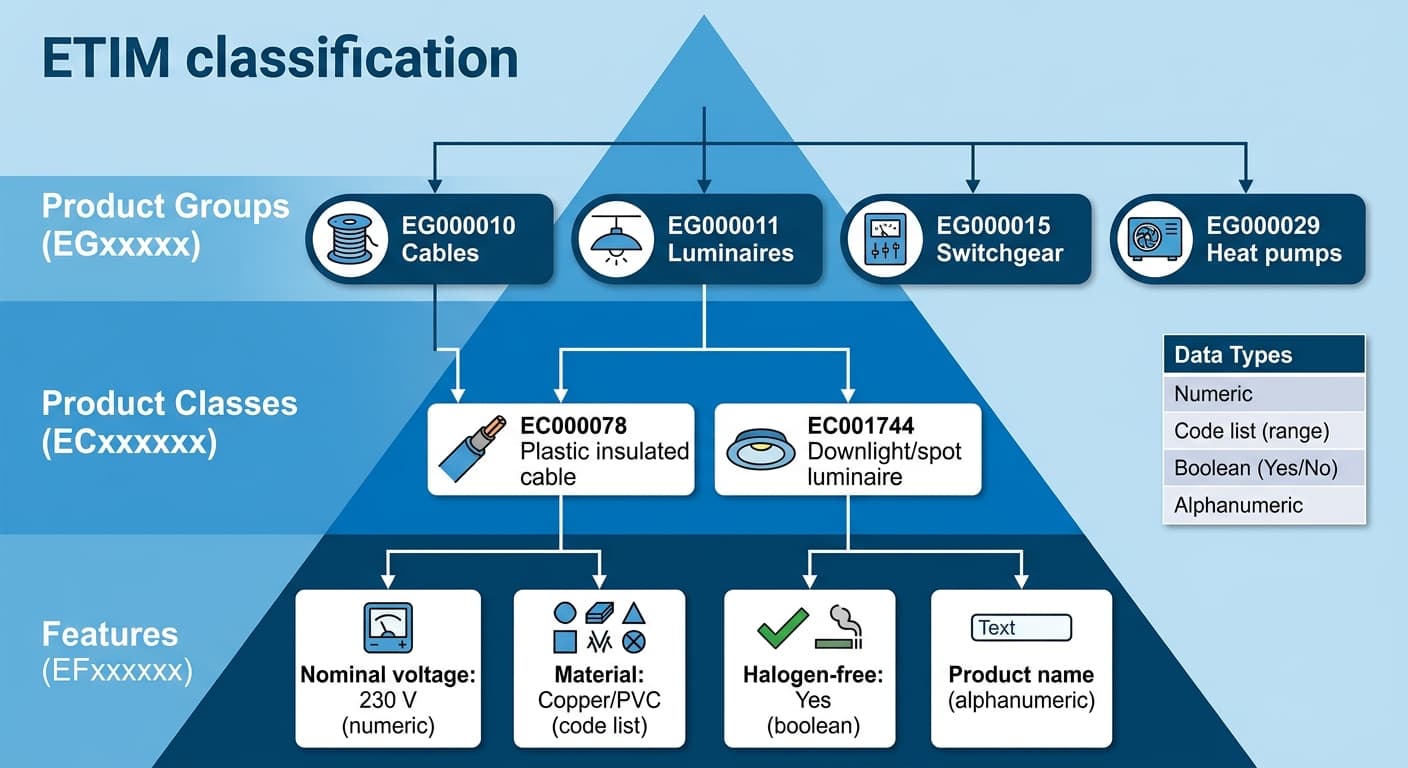
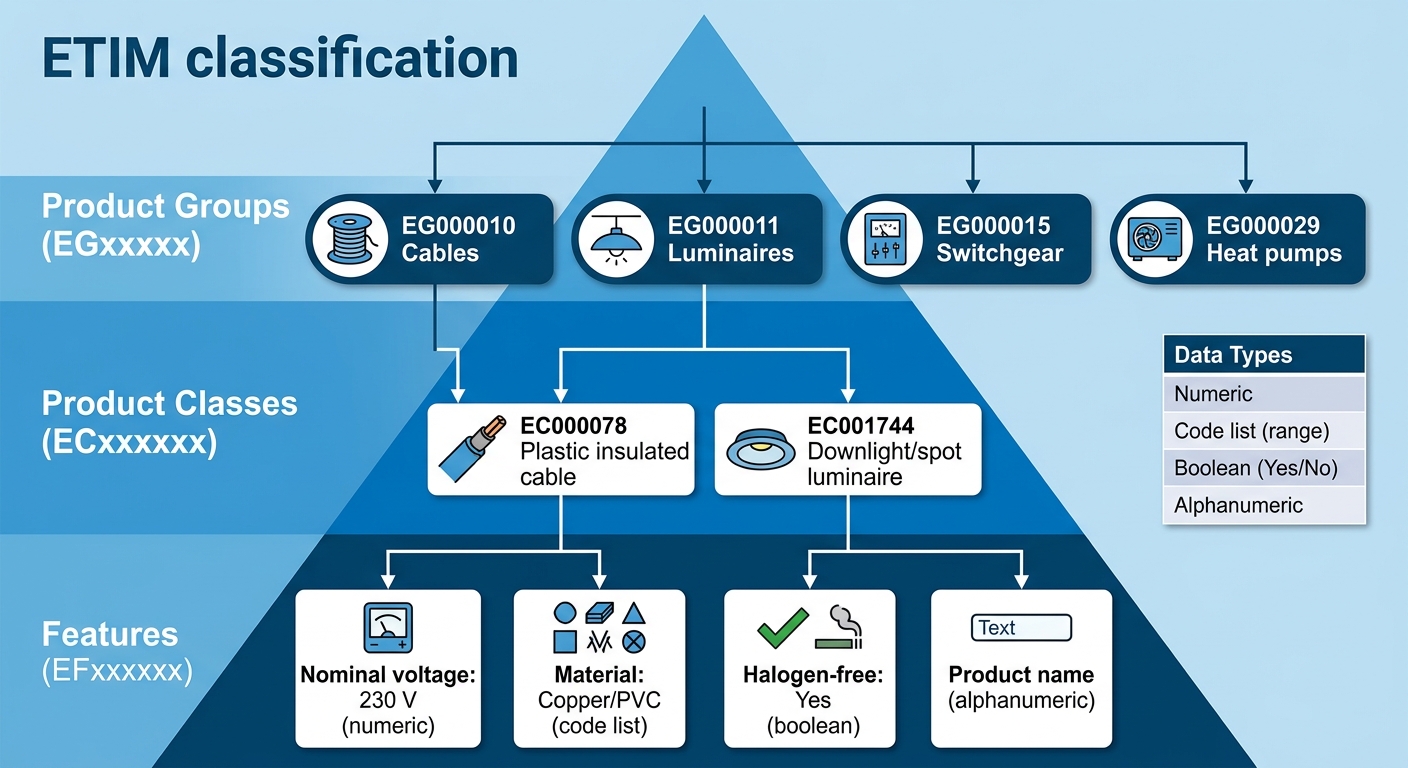
ETIM classification isn't a deep multi-level tree like eCl@ss. It's straightforward with three main layers:
-
Product Groups (EGxxxxxx codes): Broad categories, around 170 in the latest releases. Examples: EG000010 (Cables), EG000011 (Luminaires), EG000015 (Switchgear), EG000029 (Heat pumps).
-
Product Classes (ECxxxxxx codes): Specific types within groups, over 5,000 total. These are the "buckets" for your SKUs. E.g., under Cables: EC000078 (Plastic insulated cable).
-
Features (EFxxxxxx codes): Properties tied to each class, up to 20-30 per class. Features are mandatory (must-fill) or optional, with predefined data types:
Data Type Description Example Alphanumeric Free text with limits "Product name" Code list Dropdown from ETIM values "Material: Copper / PVC" Numeric Number + unit "Nominal voltage: 230 V" Boolean Yes/No "Halogen-free: Yes"
ETIM releases new versions annually (e.g., version 9.0 or 10.0 by 2026), with updates to classes, features, and value lists. Each country adapts it slightly but keeps the core identical for cross-border trade.[6]
Real-World Example: Mapping an "LED Downlight"
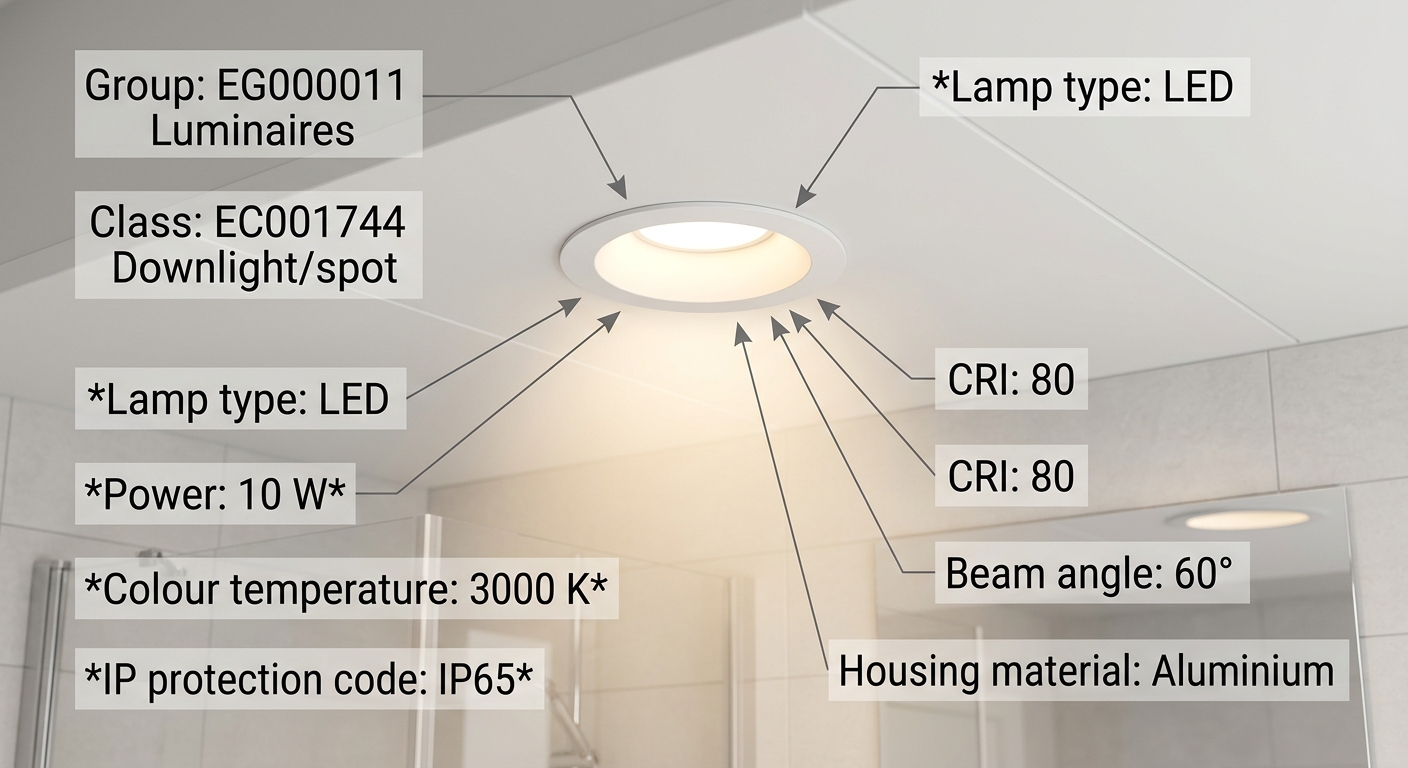
Let's classify a common product: a recessed LED downlight (10W, 3000K, IP65-rated for bathrooms).
- Group: EG000011 - Luminaires (light fixtures).
- Class: EC001744 - Downlight/spot luminaire/floodlight.[7]
- Key Features (mandatory ones starred):
- Lamp type: LED
- Power: 10 W
- Colour temperature: 3000 K
- IP protection code: IP65
- Colour rendering index (CRI): 80
- Beam angle: 60 degrees
- Housing material: Aluminium
- Suitable for: Indoor / Outdoor
This structure lets buyers filter "all IP65 LED downlights under 15W with CRI >80." Without ETIM classification, your product is just a generic listing.[8]
Other examples:
- HVAC Valve: Group EG000057 (Valves), Class EC003454 (Control valve), Features: Nominal diameter (DN15), Pressure (PN16), Medium (Water).
- Cable: Group EG000010 (Cables), Class EC000078 (Plastic insulated cable), Features: Cross-section (1.5 mm²), Core count (3), Voltage (300/500V).
- Switch: Group EG000015 (Switchgear), Class EC000484 (Changeover switch), Features: Rated current (16A), Poles (4), IP rating (IP20).
Why Are Your Customers Asking for ETIM Classification?
Industrial distribution is going digital—fast. Wholesalers like Rexel, Sonepar, and Faber are building e-commerce platforms that rival Amazon for B2B. But technical buyers need more than photos and prices: they want specs to narrow 10,000+ options.
ETIM classification powers this:
- Structured Search: Filter by voltage, IP rating, or material without keyword guessing.
- Data Pools: Distributors feed shared catalogs (e.g., ETIM Trade) where 80% of data must be ETIM-compliant.
- Efficiency: Reduces returns (wrong spec) and speeds quoting by 50%.[9]
Your big customers—regional distributors or national chains—are mandating it in RFQs or portals. Ignore it, and you're sidelined for competitors with ETIM-ready data. In Europe, it's near-universal; in North America, adoption is surging via ETIM-NA.[10]
What Does ETIM Compliance Actually Require?
True compliance means three steps for each SKU:
-
Classify the Product: Assign the right Group/Class based on primary function. Use ETIM's synonyms (multilingual keywords) to match your descriptions.
-
Fill Feature Values: Complete all mandatory features accurately. Use only ETIM-approved value lists to avoid rejection. Optional features boost discoverability.
-
Export in ETIM xChange Format: Package data as a standardized file for upload to customer portals.
No certification body "approves" you—compliance is self-assessed, but buyers validate via their PIM systems. Start with version matching your market (e.g., ETIM 9.0 for EU).[11]
The Practical Challenges of ETIM Classification for Manufacturers
You manage 5,000 SKUs across an ERP like SAP or Dynamics. Each has datasheets, but not structured for ETIM. Here's why manual ETIM classification hurts:
- Scale: Classifying 5,000 items takes 1-2 FTEs for 6-12 months. Features require engineering input.
- Expertise Gap: Product managers know the items; data teams know ETIM. Rare overlap.
- Maintenance: Annual ETIM updates mean reclassifying 10-20% of SKUs. New products? Same pain.
- Data Quality: Legacy ERPs have inconsistent specs (e.g., "high voltage" vs. "1000V"). Mismatches lead to 30% rework.[5]
Result: Delayed launches, lost sales, frustrated customers. A 200-person manufacturer can't afford a dedicated team.
How to Approach ETIM Classification Without a Dedicated Team
You don't need to boil the ocean. Use the 80/20 rule: Focus on top-revenue products first. Here's a phased plan powered by AI:
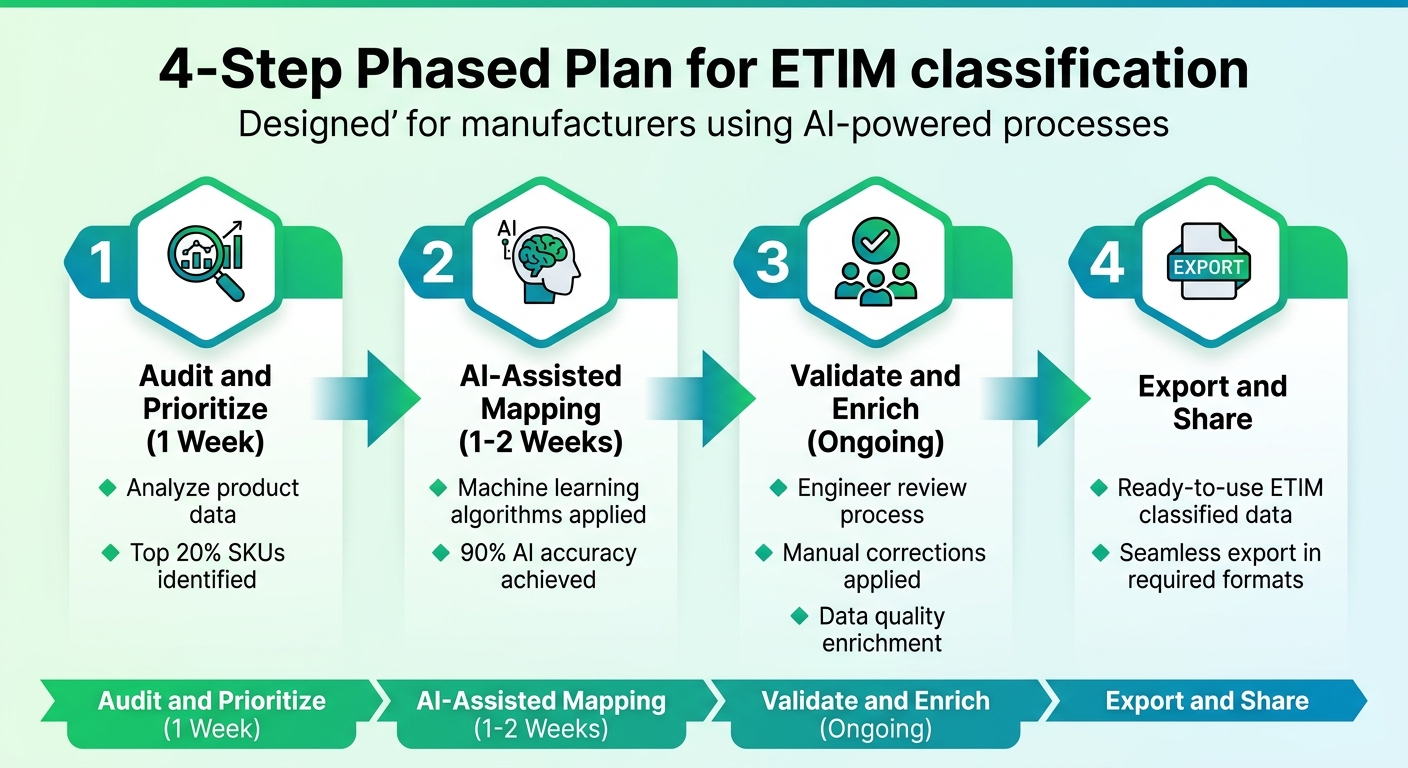
Step 1: Audit and Prioritize (1 Week)
Export your top 20% SKUs (by sales volume). Use ERP fields like description, specs, images.
Step 2: AI-Assisted Mapping (1-2 Weeks)
Upload to an AI PIM like FacetFlux. It scans descriptions/docs to suggest classes/features—90% accurate out-of-box. Review outliers with your team.
Example: Feed "IP65 10W recessed LED downlight, 3000K" → Auto-maps to EC001744, fills power/color temp.
Step 3: Validate and Enrich (Ongoing)
Spot-check 10% manually. Engineers approve edge cases (e.g., custom HVAC pumps). Iterate: AI learns from feedback.
Step 4: Export and Share
Generate ETIM xChange files. Test-upload to a customer portal.
Tools to Accelerate
- AI PIMs (FacetFlux): Auto-classify from unstructured data.
- ETIM Excel Downloads: Free from etim-international.com for reference.
- Integrations: Link ERP → PIM → xChange.
Scale to full catalog in 3 months, maintaining quarterly.
For HVAC thermostats: AI matches "digital room thermostat, 230V" to EG000225 (Thermostats), EC001857 (Electronic motorised valve).
Common Mistakes in ETIM Classification (and How to Avoid Them)
Even pros slip up. Top pitfalls:
-
Wrong Class Selection: Picking too broad (e.g., generic "luminaire" vs. EC001744 downlight). Fix: Use ETIM search tools/synonyms; AI previews matches.
-
Incomplete Feature Values: Skipping mandatories like "nominal diameter" on valves. Fix: PIMs flag them red.
-
Ignoring Mandatory Fields or Value Lists: Free-texting "medium voltage" instead of "1kV". Fix: Dropdown enforcement.
-
Version Mismatch: Using old classes. Fix: Specify release (e.g., 9.0).
-
Overlooking Synonyms: Misses searches. Fix: Add all relevant.
-
No Images/Safety Data: ETIM encourages extras. Fix: Bundle in exports.
Guidance notes (e.g., ETIM UK's lighting PDF) help for tricky categories.[12]
ETIM xChange Export Format: What It Is and Who Accepts It
ETIM xChange is the gold-standard export: a JSON-based file (zipped) for classified data. Launched in 2024 (now v2.0+), it replaces BMEcat for better machine-readability and global use.[13][14]
Structure:
- Header: Supplier info, ETIM version.
- Products: Array of SKUs with class, features, images, prices.
- Multilingual: Supports 20+ languages.
Who Accepts It:
- EU Giants: Rexel, Sonepar, Wolseley.
- Data Pools: ETIM Trade, CLASSIFY.
- PIMs: Pimcore, AtroPIM.
- North America: Growing via ETIM-NA portals.
Export once, upload everywhere. FacetFlux generates it natively.
Get ETIM-Ready Today
ETIM classification isn't optional—it's your ticket to digital distributors. Start small, leverage AI, and watch sales flow.
Upload your product catalog. FacetFlux maps your data to ETIM classes automatically—review, refine, export.