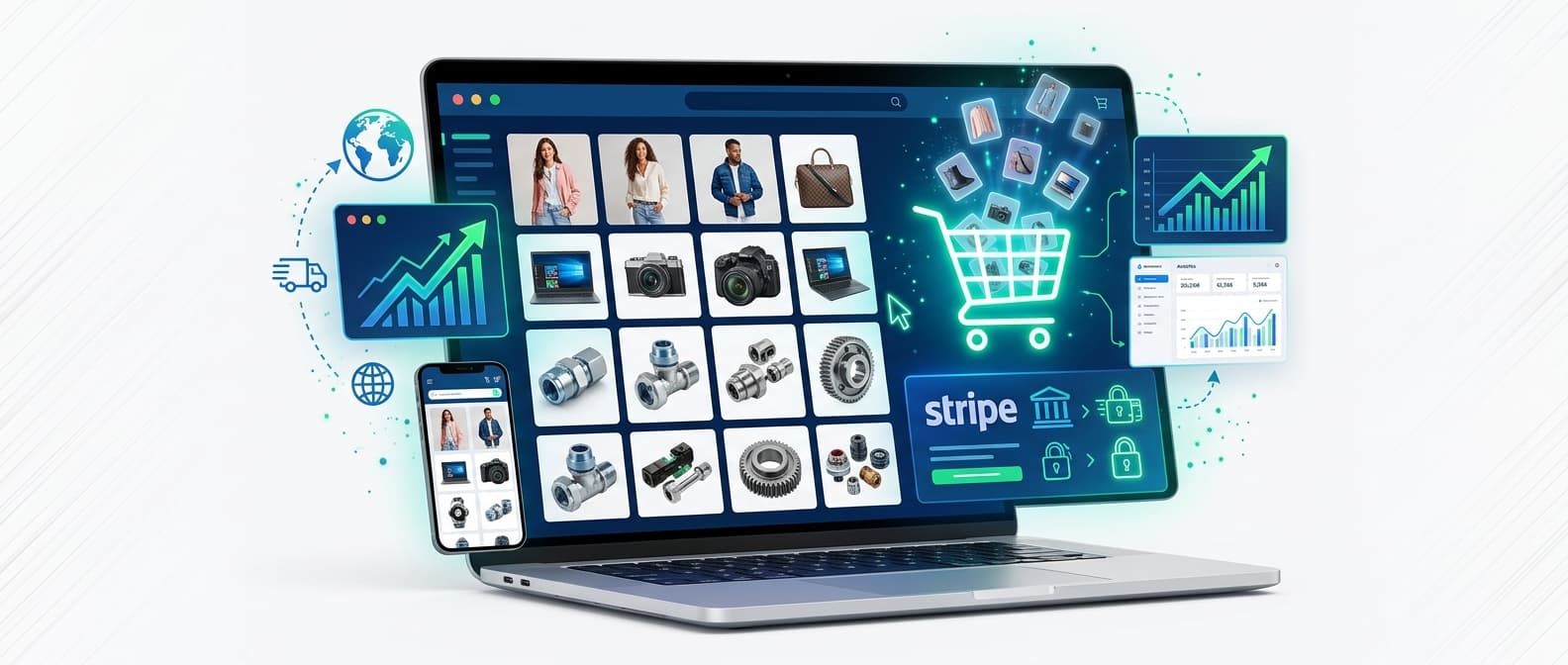
The Complete Guide to E-commerce Software
E-commerce software powers the digital storefronts where businesses sell products and services online, transforming traditional retail into seamless, scalable operations. At its core, e-commerce software provides the tools to build, manage, and optimize online stores, handling everything from product listings and shopping carts to payments and customer support. Whether you're launching a small boutique or scaling a global enterprise, the right e-commerce software can streamline operations, boost sales, and deliver exceptional customer experiences.[1][2]
What is E-commerce Software?
Definition: E-commerce software, also known as e-commerce platforms, is a suite of digital tools that enables businesses to create and run online stores. It integrates website building, inventory management, order processing, and marketing features into a single system, eliminating the need for multiple disparate tools.
Unlike basic website builders, e-commerce software is purpose-built for transactions. It supports secure payment gateways, tax calculations, shipping integrations, and analytics to track performance. For businesses dealing with complex inventories—like industrial suppliers managing hydraulic fittings or electrical components—this software ensures product data is accurately displayed across channels, reducing errors and enhancing buyer trust.
The evolution of e-commerce software traces back to the late 1990s with platforms like early versions of Magento, but today's solutions leverage cloud computing, AI, and APIs for agility. Global retail e-commerce sales hit an estimated $1.234 trillion in the US alone in 2025, underscoring the massive opportunity.[3] Worldwide, B2C e-commerce revenue is projected to reach $3.88 trillion in 2026.[4]
Key Takeaway: E-commerce software isn't just a website—it's the engine driving revenue in a market where online sales continue to surge, with platforms adapting to mobile, AI-driven shopping, and omnichannel demands.
The E-commerce Software Market: Size, Growth, and Opportunities
The e-commerce software market is booming, valued at around $13.10 billion in 2026 and forecasted to expand to $44.32 billion by 2034 at a compound annual growth rate (CAGR) of 16.46%.[5] Alternative projections peg it at $9.42 billion in 2025 growing to $34.18 billion by 2033 with an 18.5% CAGR, fueled by cloud adoption (over 68% market share) and B2B segments (54%).[6]
North America dominates with 35% share, but Asia-Pacific leads in some application segments like apparel. Key drivers include rising mobile commerce, cross-border sales, and SaaS models that lower entry barriers. Challenges like cybersecurity risks and integration complexities persist, but innovations in AI and headless architectures are addressing them.
For manufacturers and suppliers, this growth means e-commerce software must handle intricate product data—think specifications for fasteners or variants for electrical components—to compete in B2B marketplaces.
Why Your Business Needs E-commerce Software
In 2026, ignoring e-commerce software means missing out on a digital economy where 5.4% year-over-year growth in US sales signals sustained momentum.[3] Here's why it's essential:
- Scalability: Start small and grow without rebuilding. Platforms support unlimited products and traffic spikes.
- Customer Convenience: 24/7 access, personalized recommendations, and one-click checkouts reduce cart abandonment.
- Data-Driven Insights: Built-in analytics reveal top sellers, like which hydraulic fitting variant performs best.
- Omnichannel Reach: Sync data to Amazon, eBay, or social shops for broader exposure.
- Cost Efficiency: Automate inventory and orders, cutting manual rework that plagues Excel-dependent teams.
Without robust e-commerce software, businesses face lost sales—downtime alone costs retailers up to $1.1 million per hour for SMBs.
Key Takeaway: E-commerce software turns product data chaos into revenue streams, especially for data-heavy industries where accurate specs drive decisions.
Key Features to Look for in E-commerce Software
Modern e-commerce software packs features for every stage of the buyer journey. Prioritize these:
- Store Builder: Drag-and-drop editors for responsive designs.
- Product Management: Variants, bundles, SEO-optimized descriptions, and rich media (images, videos).
- Payments & Security: PCI-DSS compliance, 100+ gateways like Stripe/PayPal, fraud detection.
- Inventory & Orders: Real-time tracking, multi-warehouse, automated fulfillment.
- Marketing Tools: Abandoned cart recovery, email/SMS, SEO, discounts.
- Analytics & Reporting: Sales dashboards, customer segmentation.
- Integrations: 1,000s of apps for ERP, CRM, accounting.
- Mobile & International: Multi-currency, localization.
For complex catalogs, advanced product data handling—attributes, classifications, syndication—is crucial.
| Feature Category | Essential | Advanced |
|---|---|---|
| Payments | Stripe, PayPal, PCI compliance | Global gateways, BNPL (e.g., Affirm) |
| Inventory | Real-time stock, low-stock alerts | Multi-channel sync, bundle kits |
| Customization | Themes, drag-drop | Headless APIs, custom code |
| Analytics | Basic sales reports | AI insights, customer lifetime value |
| Support | Email/chat | 24/7 phone, dedicated managers |
This table highlights must-haves vs. growth enablers.[2]
Types of E-commerce Software
E-commerce software comes in four main types, each suiting different needs:
- SaaS (Software as a Service): Hosted platforms like Shopify or BigCommerce. Pros: Easy setup, automatic updates, scalability. Cons: Monthly fees (starting $29), less customization. Ideal for beginners/SMBs.
- Open-Source/Self-Hosted: WooCommerce (WordPress), PrestaShop, OpenCart. Pros: Free core, full control. Cons: Hosting/security maintenance, developer needed.
- Headless Commerce: Decouples frontend (e.g., Next.js) from backend (e.g., Shopify Plus, Medusa). Pros: Flexibility for custom UIs, faster loads. Cons: Higher complexity/cost. Growing at 16.5% CAGR in North America.[7]
- POS-Integrated: Square Online, Lightspeed. Blends online/offline for retail hybrids.
| Type | Ease of Use | Cost | Scalability | Best For |
|---|---|---|---|---|
| SaaS | High | Subscription ($29+) | High | SMBs, quick launch |
| Open-Source | Medium | Free + hosting | Medium-High | Custom needs, budget |
| Headless | Low | High (dev) | Very High | Enterprises, apps |
| POS-Integrated | High | Transaction fees | Medium | Brick-and-mortar |
Choose based on technical expertise and catalog complexity.[8]
E-commerce Software for B2B vs. B2C
B2C focuses on impulse buys (e.g., fashion), while B2B handles high-value, repeat orders (e.g., bulk fasteners). B2B e-commerce software needs:
- Custom pricing/quote requests
- Account dashboards
- Bulk ordering
- Compliance (e.g., REACH for EU suppliers)
B2B holds 54% market share; platforms like BigCommerce excel here.[5]
How to Choose the Right E-commerce Software
Selecting e-commerce software requires balancing needs, budget, and growth. Read our How to Choose the Right E-commerce Software for a step-by-step process. Key steps:
- Assess inventory size/complexity (e.g., 10K+ SKUs for electrical components?).
- Test demos for UX.
- Check integrations with ERP/Excel exports.
- Review pricing: $5-500+/mo + 0-2% fees.
- Prioritize support and uptime (99.99% SLA).
For data-heavy ops, ensure robust attribute management.
Top E-commerce Software Mistakes to Avoid
Common pitfalls include underestimating product data quality, poor mobile optimization, and ignoring integrations. Dive deeper in Top E-commerce Software Mistakes to Avoid. Pro tip: Audit data pre-launch—bad specs lose listings.
E-commerce Software Comparisons and Buying Guide
Compare leaders:
- Shopify: Best overall (4.8/5 ease), 13K+ apps, AI tools. Starts $29/mo.[9]
- BigCommerce: B2B/scalable, no transaction fees. $29/mo.
- Wix: Beginner-friendly, versatile. $27/mo.
- WooCommerce: Free, flexible.
See E-commerce Software vs Alternatives: A Comparison and Buying Guide.
| Platform | Rating | Starting Price | Strengths |
|---|---|---|---|
| Shopify | 4.8/5 | $29/mo | Apps, scalability |
| BigCommerce | 4.5/5 | $29/mo | B2B, no fees |
| Wix | 4.6/5 | $27/mo | Design ease |
| WooCommerce | 4.4/5 | Free | Customization |
The Role of Product Data in E-commerce Software
High-quality product data is the backbone of effective e-commerce software. For industrial suppliers, structured data—dimensions, materials, certifications—prevents mismatches, like ordering wrong hydraulic fittings. Poor data leads to 30% cart abandonment.
E-commerce software with strong data tools enables:
- Attribute-rich listings
- Real-time syndication to channels
- AI-enriched descriptions/images
Upload your product data. See it organized in seconds with FacetFlux.
Implementing E-commerce Software: A Step-by-Step Guide
- Plan: Map products, audience, channels.
- Select & Migrate: Import data (CSV/API).
- Customize: Themes, apps.
- Test: Payments, mobile.
- Launch & Optimize: A/B tests, SEO.
Budget 2-6 weeks for SMBs.
E-commerce Software Trends in 2026
- AI Integration: Personalization, chat agents (Shopify Magic).[11]
- Headless Growth: MACH architectures for speed.[12]
- Privacy Regulations: New 2026 laws (Indiana CDPA, etc.) demand consent, data mapping.[13]
- Social/Live Commerce: TikTok Shops.
- Sustainability: Carbon tracking.
Stay ahead with composable commerce.
FAQ: E-commerce Software Essentials
What is the best e-commerce software for beginners?
Shopify tops lists for its ease (4.8/5), trials, and ecosystem.[9]
How much does e-commerce software cost?
$29-500+/mo + fees; free tiers limited.
Shopify vs. BigCommerce: Which is better for B2B?
BigCommerce for wholesale; Shopify for general scale.
Do I need coding for e-commerce software?
No for SaaS; yes for open-source/headless.
How does e-commerce software handle inventory?
Real-time sync, alerts; integrates with ERPs.
What are the top trends in e-commerce software for 2026?
AI personalization, headless, privacy compliance.[14]
Can e-commerce software integrate with marketplaces?
Yes, via APIs/apps for Amazon, eBay.
Is e-commerce software secure?
Look for PCI-DSS, SSL, fraud AI.
Ready to elevate your online presence? Explore FacetFlux at facetflux.com for AI-powered product data organization that supercharges any e-commerce software.