Product Data Management for Manufacturers: A Practical Guide
In the fast-paced world of manufacturing, product data management for manufacturers has become a critical yet often overlooked challenge. You might think your enterprise resource planning (ERP) system has everything covered, but scattered spreadsheets, outdated PDFs, and tribal knowledge in team members' heads tell a different story. Poorly managed product data leads to missed sales opportunities, frustrated customers, and operational inefficiencies that eat into your bottom line.
This practical guide breaks down product data management for manufacturers into actionable steps. We'll explore what product data really is, where it hides in your organization, why old habits no longer work, and how to build a centralized system that scales with digital demands. Whether you're a mid-sized fabricator or a large-scale producer, mastering product data management will help you deliver structured, accurate information to distributors, e-commerce platforms, and buyers—faster and more reliably than ever.[1]
By the end, you'll have a clear roadmap to assess your current setup, close data gaps, and leverage AI to automate the heavy lifting. Let's dive in.
What Counts as "Product Data"?
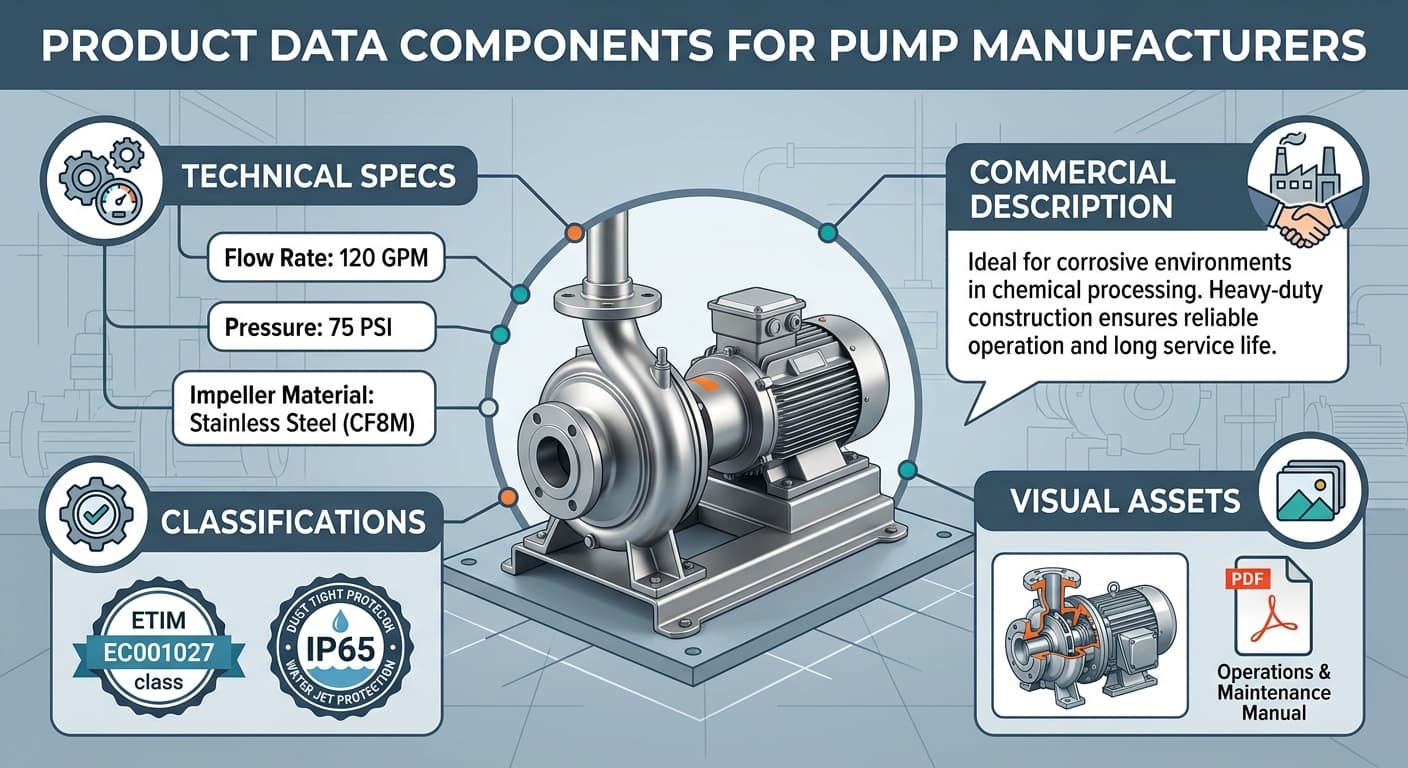
Product data is far more than a SKU and a price tag. In product data management for manufacturers, it encompasses every piece of information needed to sell, service, and support your products. Think technical specifications like dimensions, materials, tolerances, and performance ratings. Add commercial descriptions that highlight benefits, features, and use cases for sales teams and catalogs.
Visuals are crucial: high-res images from multiple angles, 360-degree views, exploded diagrams, and even 3D models. Don't forget supporting documents—CAD files, assembly instructions, safety data sheets (SDS), and warranties. Classifications and certifications round it out: industry standards like ETIM or UNSPSC, compliance badges (RoHS, UL, CE), and sustainability metrics like carbon footprint or recyclability.
This data extends beyond your ERP, which typically handles inventory levels, costs, and basic bills of materials (BOMs) for internal operations. ERP fields are optimized for production scheduling and procurement, not customer-facing e-commerce or distributor portals. Product data for external use must be enriched, structured, and format-specific—think attribute-value pairs for faceted search on platforms like Amazon Business or Grainger.
Actionable Insight: Audit your product portfolio. List 10 SKUs and note all data types available. You'll likely find 70% lives outside your ERP, creating silos that complicate product data management for manufacturers.[2]
For example, a pump manufacturer might have:
- Technical: Flow rate (GPM), pressure (PSI), impeller material (stainless steel).
- Commercial: "Ideal for corrosive environments in chemical processing."
- Assets: Cutaway image, PDF manual.
- Classifications: ETIM class EC001027, IP65 rating.
Ignoring these leads to incomplete listings. Comprehensive product data ensures buyers find, compare, and trust your offerings.
Where Product Data Lives in a Typical Manufacturer
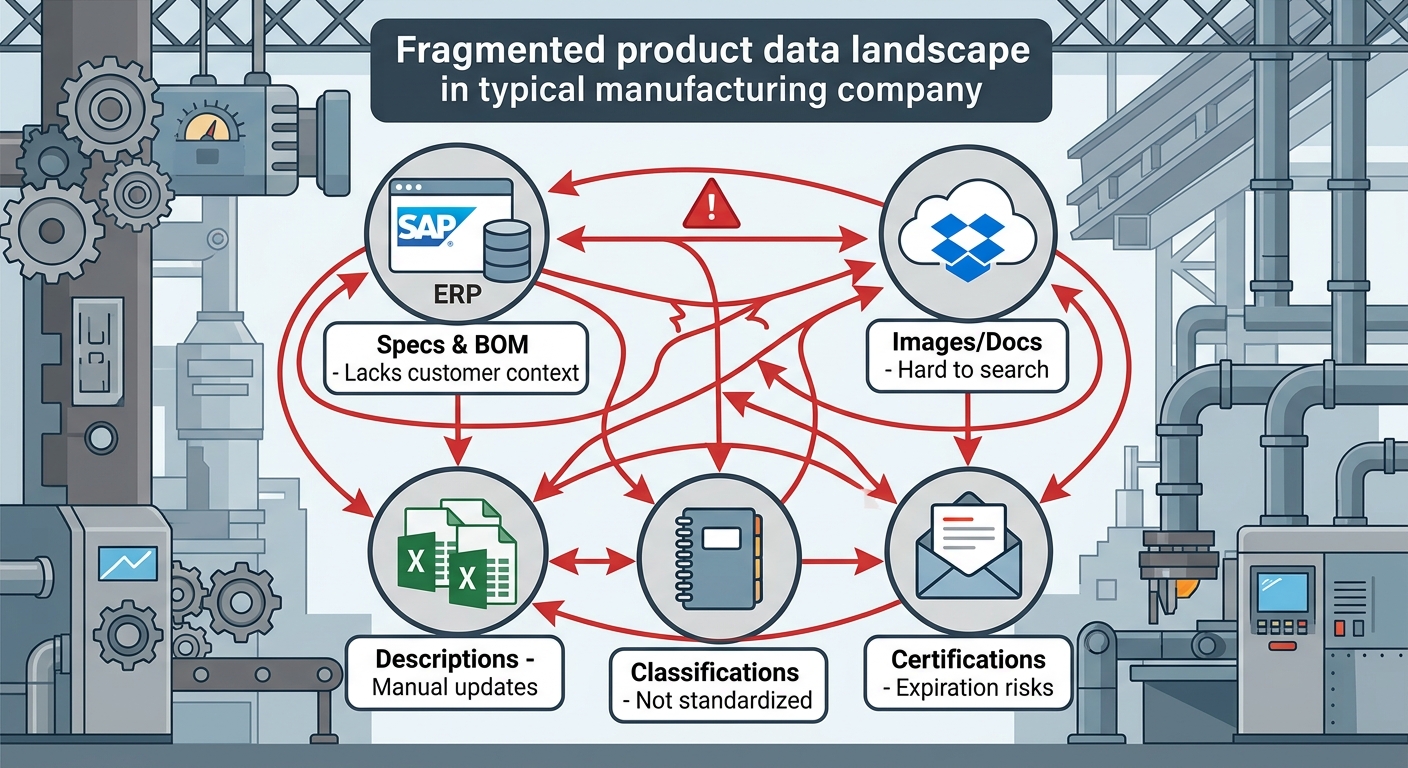
In most manufacturing operations, product data is fragmented across a patchwork of tools—none designed for seamless product data management for manufacturers. Your ERP (like SAP or Epicor) captures core operational fields: part numbers, costs, lead times, and basic descriptions for MRP and quoting. It's great for internal ops but lacks richness for sales.
Customer requests? They land in Excel spreadsheets emailed back and forth. Sales reps maintain ad-hoc sheets with pricing tiers, regional variants, and competitor comparisons. Print catalogs? Locked in static PDFs from last year's photoshoot, with specs that drift out of sync.
The rest? It's in the product manager's head—nuanced insights like "this alloy works better in humid climates" or "avoid pairing with PVC fittings." Engineering drawings pile up in shared drives, images in Dropbox folders, and certifications in email archives.
This siloed reality stems from legacy systems. Legacy ERPs prioritize transactions over content, while tools like Excel excel (pun intended) at quick hacks but fail at scale. A typical mid-sized manufacturer juggles 5-10 data sources per product line, leading to version control nightmares.[3]
Visualize Your Data Landscape:
| Data Type | Common Location | Pain Point |
|---|---|---|
| Specs & BOM | ERP | Lacks customer context |
| Descriptions | Excel/Word | Manual updates |
| Images/Docs | File shares | Hard to search |
| Classifications | Product manager's notes | Not standardized |
| Certifications | Emails/PDFs | Expiration risks |
Practical Tip: Map your data flows. Interview sales, engineering, and ops teams: "Where do you go for [specific data]?" This reveals gaps before you invest in fixes.
Why This Worked Before and Doesn't Anymore
Pre-digital era, product data management for manufacturers was straightforward. Print catalogs shipped quarterly, sales reps handed out spec sheets, and distributors managed their own listings. Data was static; a PDF sufficed because buyers couldn't compare 50 competitors instantly.
Digital distribution flipped the script. Distributors now power e-commerce sites demanding structured feeds—CSV, XML, or API endpoints with mandatory attributes. Platforms like Zoro or MSC Industrial require ETIM classifications for faceted search; miss it, and your products vanish from filters.
Buyers compare online: "Show me 2-inch valves under 500 PSI with NSF certification." Unstructured data fails here. E-commerce exploded—B2B online sales hit $1.7 trillion in 2025—amplifying the need for digital-ready product data.
Global supply chains add complexity: regional variants (voltage, language), compliance per market. What worked for 100 SKUs fails at 10,000. Manual processes that tolerated 20% error rates now demand 99% accuracy.
Shift Summary:
- Then: Print-first, rep-driven sales.
- Now: Digital-first, self-serve buyers.
Manufacturers ignoring this lag: lost visibility on key channels, slower market entry.
The Demand-Side Pressure: What Your Customers Actually Want
Your customers—distributors, OEMs, end-users—crave structured, classified, enriched data in their format. Not a PDF dump; they need Excel with columns for searchable attributes, BMEcat for ERP import, or JSON for their marketplace.
Distributors want ETIM or eCl@ss for categorization, enriched titles/descriptions for SEO, and multimedia for product pages. Platforms reject incomplete feeds: Amazon Business mandates 10+ images and A+ content; miss specs, get delisted.
Buyers demand transparency: sustainability data, digital twins for simulation, cross-references to competitors. A McKinsey survey notes 70% of B2B buyers switch suppliers over poor online experience.[5]
Customer Wishlist:
- Structured: Attribute-value pairs (e.g., "Voltage: 230V").
- Classified: Standard taxonomies.
- Enriched: Compelling copy, 360° views.
- Format-Specific: Their API or spec sheet.
Deliver this, win loyalty. Fail, and they source elsewhere.
The Cost of the Status Quo
Fragmented data extracts a heavy toll. Lost listings: Incomplete feeds mean zero visibility—potentially 20-30% of revenue from top channels.[6]
Manual rework: Every customer request triggers hours of Excel gymnastics, costing $50-100 per hour in labor. Scale to 50 requests/month: $30K+ annually.
Inconsistent data: Varying specs across channels erode trust, spike returns (up to 15% higher).
Slow time-to-market: New products launch 3-6 months late waiting for data prep.
Overall, poor data quality costs organizations $12.9 million yearly on average—multiplied across manufacturing's scale.[7]
ROI Calculator (Rough):
- Hours/week on data fixes: 20 → $50K/year.
- Lost sales from poor listings: 10% → $500K+.
Time to fix.
What "Good" Product Data Management Looks Like
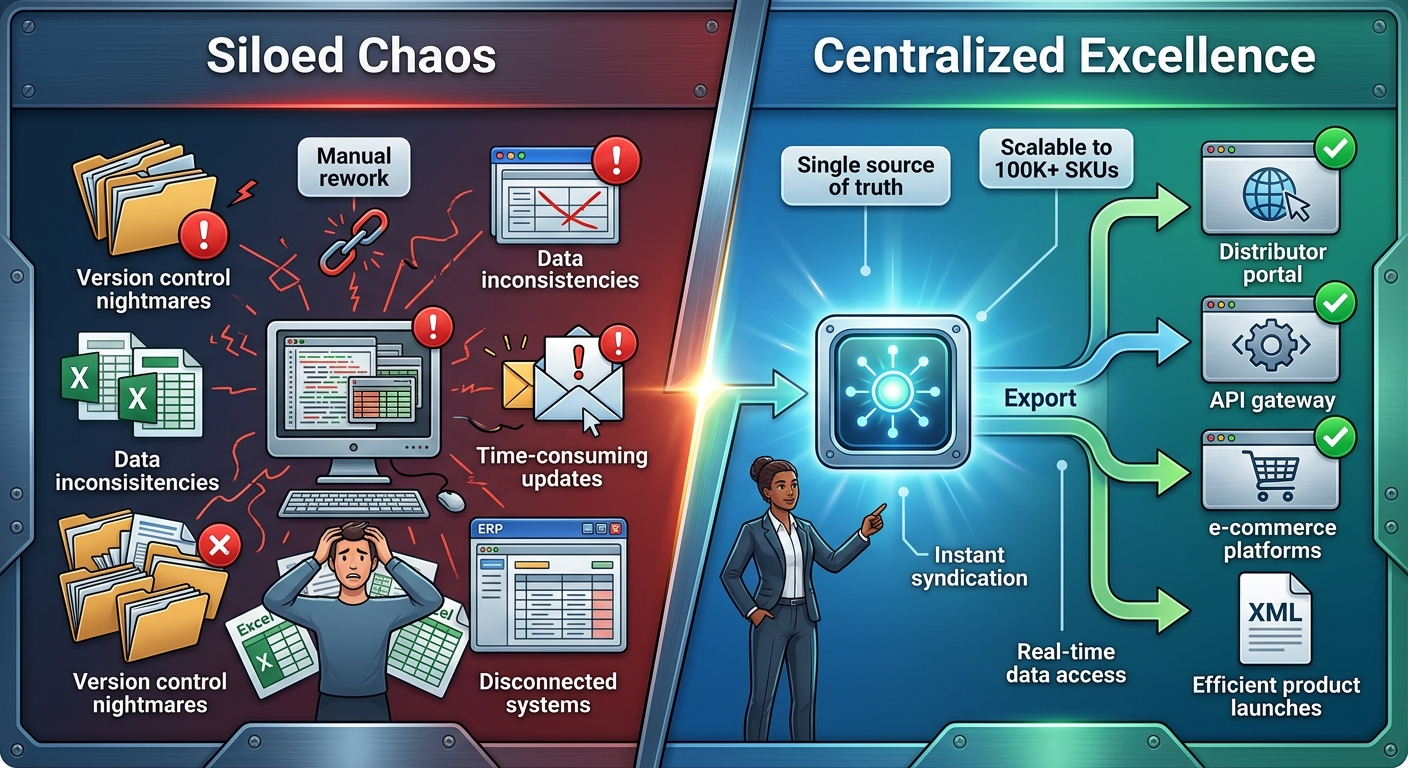
Effective product data management for manufacturers centers on one source of truth: a centralized repository where attributes are defined once, maintained by owners, and exported anywhere.
This product data system ingests all sources (ERP, Excel, docs), standardizes via rules/AI, and syndicates: ETIM to distributors, custom CSV to platforms, API to partners. Changes propagate instantly—no recuts.
Hallmarks of Excellence:
- Centralized: Single hub, role-based access.
- Scalable: Handles 100K+ SKUs.
- Flexible: Export any format.
- Governed: Workflows for approvals.
Benefits: Consistency reduces errors by 90%, accelerates launches 50%, boosts sales conversion 25%.[8]
Example: Valve maker centralizes specs/images; exports BMEcat weekly—listings live faster, returns drop.
Getting Started: Assess, Gap, Pilot
Don't boil the ocean. Start small for quick wins in product data management for manufacturers.
Step 1: Assess What You Have
- Inventory sources: ERP export + file shares.
- Sample 50 SKUs: Score completeness (1-10).
- Tools: Free spreadsheets or basic ETL.
Step 2: Identify Biggest Gap
- Survey customers: "What blocks listings?"
- Common: Classifications (40%), enrichments (30%).
Step 3: Pick One Customer/Format
- Target top distributor, their format (e.g., Excel spec sheet).
- Pilot 100 SKUs: Clean, enrich, deliver.
- Measure: Time saved, feedback.
Checklist:
- Data audit complete.
- Gap prioritized.
- Pilot launched (4 weeks).
- Scale plan ready.
Iterate to full system.
The Role of AI in Product Data Management
AI supercharges product data management for manufacturers, applying the 80/20 rule: Automate 80% grunt work, humans refine 20%.
Auto-Discovery: AI scans uploads (CSV/PDF), infers structure—products, attributes, hierarchies.[1]
Classification: Maps to ETIM/eCl@ss via ML, 95% accuracy.
Enrichment: Generates descriptions, normalizes units (e.g., "5cm" → "50mm"), translates languages.
Tools like FacetFlux exemplify this: Upload raw data, AI structures in seconds—no cleanup needed. Reduces manual effort 90%, perfect for resource-strapped teams.[9]
80/20 Implementation:
- AI handles bulk (discovery/classify).
- Experts validate.
- Result: Structured catalog ready for export.
Future: Predictive enrichments from market trends.
Ready to Transform Your Product Data?
Mastering product data management for manufacturers isn't optional—it's your competitive edge. Start with one source of truth, powered by AI, and watch sales soar.
Upload your product data. FacetFlux organizes it in seconds—see your catalog structured for the first time. Visit https://www.facetflux.com today.