Catalog Management vs Alternatives: A Comparison
For industrial manufacturers handling thousands of SKUs like hydraulic fittings, electrical components, and fasteners, managing product catalogs efficiently can mean the difference between seamless distributor fulfillment and constant data firefighting. In this catalog management comparison, we'll cut through the noise: dedicated catalog management outperforms spreadsheets, ERP exports, DAM tools, and manual processes in scalability, accuracy, and speed—especially as EU regulations like the Digital Product Passport demand structured sustainability data by 2026.
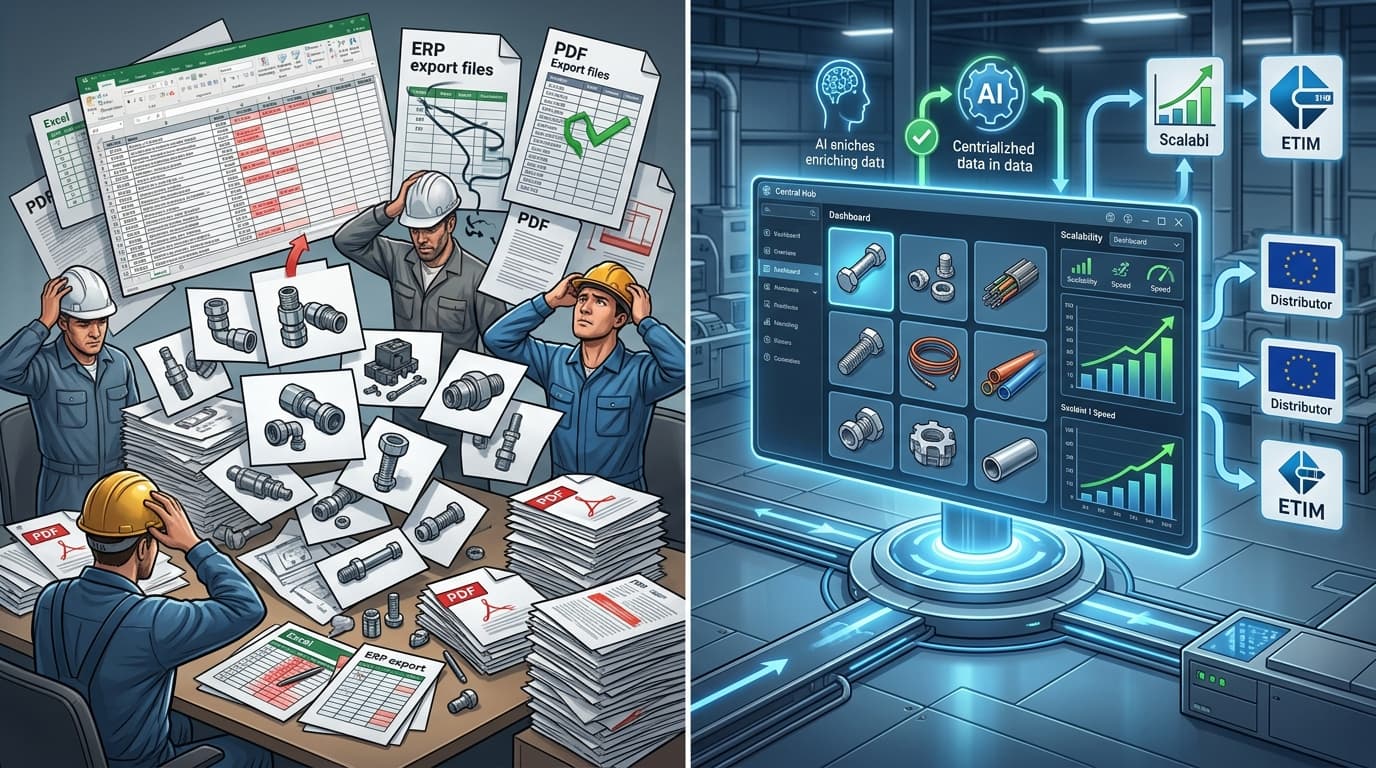
Catalog management centralizes product data—attributes, specs, images, pricing, and compliance info—into a single, AI-enriched hub for easy syndication across channels. Alternatives often suffice for tiny catalogs but crumble under volume or complexity. Let's break it down.
What Makes Catalog Management Stand Out?
Catalog management goes beyond basic storage. It structures data dynamically: think variant modeling for a hydraulic fitting family (e.g., thread sizes M10-M20, pressure ratings 200-500 bar), automated validation for EU-compliant material declarations, and real-time enrichment via AI to flag missing certifications or generate multilingual descriptions.
Unlike rigid alternatives, it handles millions of SKUs with workflows for approvals, bulk imports from ERP/Excel, and multichannel outputs (ETIM formats for European distributors, eCl@ss classifications for fasteners). The global market for such solutions is booming, valued at USD 15.7 billion in 2025 and projected to hit USD 34.7 billion by 2034, driven by manufacturing needs for centralized data.
In practice, teams using catalog management reduce manual data transfers from 9+ hours per week per employee, cutting errors by up to 95% and speeding time-to-market by 40-50%. For a mid-sized supplier with 50,000 electrical components, this means distributors get clean ETIM 9.0 exports instead of sifting through mismatched PDFs.
Common Alternatives to Catalog Management
Many 8-9 figure manufacturers start with what's at hand. Here's a rundown of the usual suspects.
Spreadsheets (Excel or Google Sheets)
Excel shines for small catalogs under 500 SKUs and single-channel sales. You can list hydraulic fitting specs in columns: part number, material (steel/brass), seal type (NBR/Viton), and price.
But scaling hits walls fast. Duplicates creep in across 100+ sheets, formulas break on bulk updates, and version control? Forget it—one overwrites another's distributor-ready file. Reddit threads from manufacturers echo this: "Beyond 10k SKUs, spreadsheets become a nightmare of manual merges."
ERP Data Exports
Systems like SAP or Dynamics store core data (inventory, BOMs for fasteners), but exports are siloed snapshots. Pulling structured catalogs requires custom reports: e.g., CSV dumps lacking variant hierarchies or images.
European suppliers exporting to distributors face pain here—ERPs excel at financials but not rich attributes like torque ratings or IP67 certifications. Knowledge workers waste 19% of time hunting data, per industry stats.
Digital Asset Management (DAM) Tools
DAM handles images and PDFs well—perfect for electrical component brochures. But structured data? Minimal. No attribute normalization, syndication, or AI deduplication.
For a fasteners catalog, you'd store bolt photos separately from spec sheets, forcing manual merges for distributor portals.
Manual Processes (PDFs and Shared Drives)
The baseline: PDFs of catalogs emailed quarterly. Cheap upfront, but error-prone and non-scalable. Updates mean recreating docs; compliance tracking (e.g., RoHS for electronics) is guesswork.
Head-to-Head Catalog Management Comparison
To make this catalog management comparison concrete, consider these key dimensions for a 20,000-SKU industrial supplier:
| Metric | Catalog Management | Spreadsheets | ERP Exports | DAM | Manual |
|---|---|---|---|---|---|
| Scalability (SKUs) | Millions, variants handled natively | <5k, breaks on growth | 100k+, flat exports | <10k assets | Unlimited, unusable |
| Data Accuracy | AI validation, 95% error reduction | High manual errors/duplicates | ERP-consistent, no enrichment | Asset-focused | Prone to outdated info |
| Time to Syndicate | Seconds (AI prep from 20min to 2min) | Hours/days per channel | Days (custom reports) | Minutes for assets | Weeks |
| Cost Efficiency | ROI via 12-30% conversion lift; 6x faster than Excel | Free, hidden rework costs | Included in ERP, export fees | $50-200/mo | Labor-heavy |
| Compliance (EU DPP) | Built-in sustainability tracking | Manual columns | Partial (BOM data) | None | Ad-hoc |
Catalog management wins on integration too: seamless ERP pulls, API syndication to distributor portals, and analytics for demand forecasting—vital as 57% of organizations lack sustainability strategies.
Real-World Example: A German Fasteners Supplier
Take Mittelstand manufacturer FastFix GmbH (8-figure revenue), producing 15,000 fastener variants. Their ERP spat CSV dumps; Excel merges for distributors took 12 hours weekly. Post-catalog management switch: AI structured data by DIN/ISO norms, auto-generated eCl@ss mappings, and real-time DPP prep for 2027 rollout.
Result? Distributors stopped requesting "better product data," listings went live 50% faster, and shelf space disputes dropped. This mirrors broader trends: AI cuts SKU prep 80-90%.
For deeper dives, check The Complete Guide to Catalog Management or Top Catalog Management Mistakes to Avoid.
Decision Framework: Is Catalog Management Right for You?
Use this 5-step checklist for your catalog management comparison:
- Assess Volume: >5,000 SKUs or growing? Ditch spreadsheets.
- Count Pain Points: Manual transfers >5 hours/week? ERP gaps in attributes?
- Check Channels: Need ETIM/eCl@ss for EU distributors? Require images+specs?
- Future-Proof: DPP compliance or AI analytics needed?
- ROI Calc: Weigh rework costs vs. 40% faster market entry.
If yes to 3+, catalog management delivers. Start small: import ERP/Excel samples.
For manufacturers bridging ERP to distributor-ready catalogs, explore From ERP to Structured Catalog: How Manufacturers Organize Product Data.
Why Switch Now?
As e-commerce and regulations accelerate—Asia-Pacific demand surging with 400M+ online shoppers by 2027—sticking with alternatives risks lost listings and manual hell. Catalog management future-proofs with GenAI validation, composable integrations, and real-time sync.
Ready to experience the difference? Upload your product data. See it organized in seconds.. Transform your hydraulic fittings, electrical components, or fasteners catalog today—and learn how in our Catalog Management Buying Guide.