Best PIM Alternatives for Industrial Suppliers in 2026: Enrichment Over Full Platforms
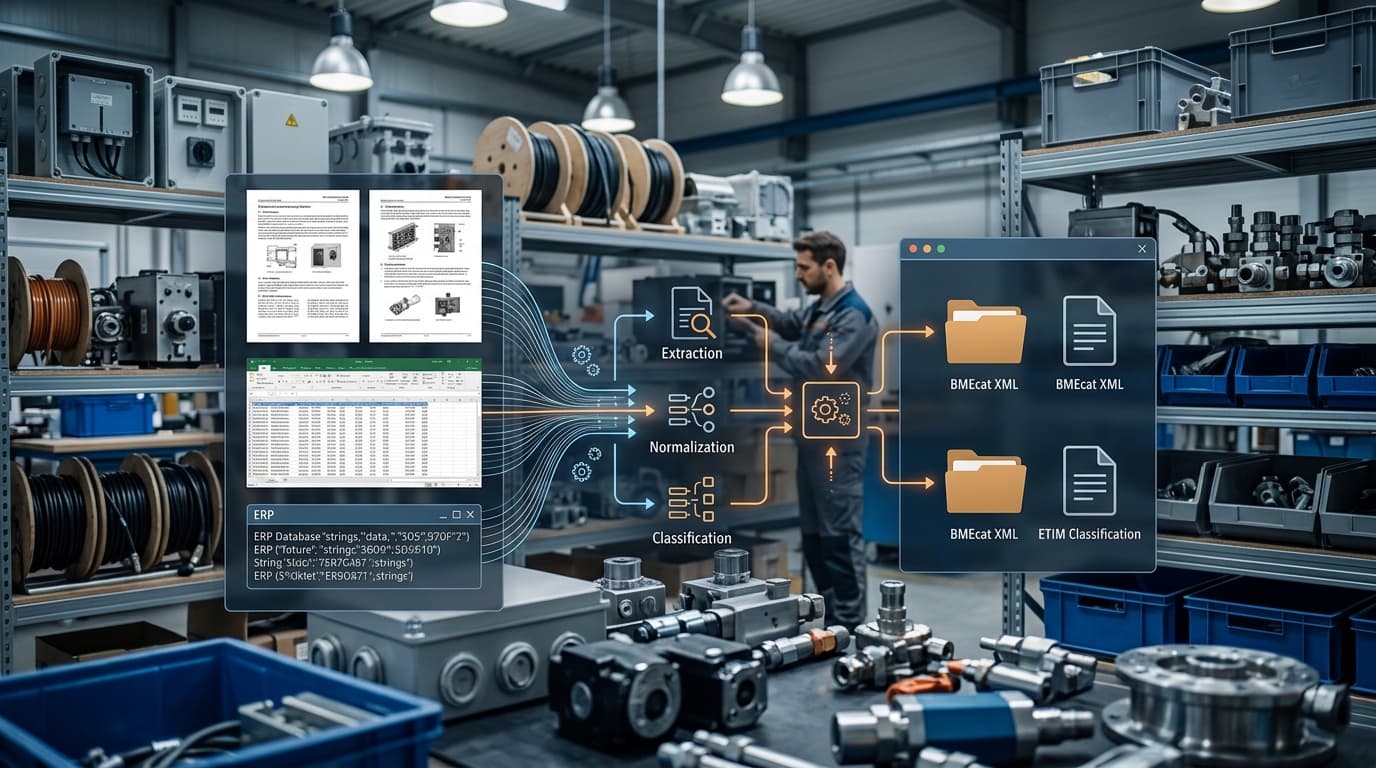
PIM alternatives for mid-size manufacturers are typically AI product data enrichment pipelines that structure, normalize, and classify existing catalog data without requiring a six-figure software migration. You don't necessarily need a massive platform to fix your data; you need an automated way to extract missing specs, execute data normalization, and generate compliant BMEcat files for your distributors.
Why Industrial Manufacturers Seek PIM Alternatives
Your biggest distributor just sent back your product data file. They told you your spec fill rate is sitting at 40%, your classification is outdated, and if you cannot provide a fully compliant BMEcat file by the end of the quarter, your products will drop in their search rankings or be delisted entirely. You look at your internal systems. Your data is fragmented. The ERP holds your SKUs, pricing, and basic weights. The detailed technical specifications—voltage ratings, thread pitches, short-circuit capacities—live in a mix of unstructured Excel spreadsheets, PDF catalog tear-sheets, and the heads of your senior sales engineers.
The immediate, reflex reaction in the industry is to buy software. You search for master data management platforms or product information management tools. You find a massive software category. According to Precedence Research, the global PIM market reached ~USD 20.95 billion in 2025 and is projected to hit USD 25.22 billion in 2026, eventually climbing to USD 121.48 billion by 2035 with a CAGR of 19.22%. The numbers look intimidating. Cloud deployments dominated with a 63.5% market share in 2025, growing at an 18.5% CAGR, but the critical context is who is actually buying these systems. Large enterprises held ~68.8% of the market share.
If you are a mid-size manufacturer with 50 to 500 employees and a catalog of 5,000 to 50,000 SKUs, you likely do not have a dedicated master data management team. You have a product manager or a technical sales lead trying to fix spreadsheet columns on a Friday afternoon.
When you buy a traditional PIM platform, you are buying an empty container. The software gives you a place to store your data, organize your workflows, and manage multi-channel syndication. But it does not magically fix the fact that 60% of your hydraulic fittings are missing their maximum pressure ratings in the system. The system will simply highlight that the data is missing. You still have to do the work of finding, extracting, and normalizing that data.
This realization is driving technical leads to evaluate PIM alternatives. They are realizing that their core problem is not a lack of database architecture; their problem is a lack of structured product data. They do not need a new interface to look at their missing data. They need product data enrichment to fill the gaps, map the values to industry standards like ETIM and eCl@ss, and format the output so the distributor's automated systems accept the file without throwing validation errors.
The Real Cost of Full PIM Implementations
When evaluating the landscape of data management, you have to look at the total cost of ownership and the timeline to value. Major platforms like Akeneo and Pimcore are powerful, well-engineered systems. They are built for organizations that require complex global syndication, distinct digital marketing workflows, multi-language consumer content, and dedicated teams to manage the daily governance of product data. If you are an enterprise retailer pushing consumer goods to fifty different global marketplaces, these platforms are exactly what you need.
But for an industrial supplier whose primary requirement is sending an ETIM-compliant file to Rexel, Sonepar, or Grainger, a monolithic platform represents a significant overshoot.
First, consider the financial reality. A full PIM implementation for a mid-market industrial company routinely runs into six figures. You pay for the software licenses, the integration agency to connect it to your ERP, the custom taxonomy design, and the months of internal meetings to define user roles and permissions. The implementation timeline is typically measured in quarters, sometimes exceeding a year before the first compliant file is successfully pushed to a distributor.
Second, consider the alternative that many manufacturers fall back on: the manual data agency. When a supplier realizes they cannot afford the time or budget for a massive software rollout, they often export their messy ERP data into an Excel file and email it to an agency. Manual agencies typically charge $2-3 per SKU for product data enrichment. If you have a catalog of 15,000 SKUs, you are looking at a $30,000 to $45,000 invoice just to get your current catalog up to standard.
Furthermore, the agency approach is inherently slow and error-prone. The agency assigns junior analysts to manually read your PDF catalogs, scrape your website, and type values into a spreadsheet. They often lack the domain expertise to understand that a "1/2 inch NPT" and a "0.5 in. National Pipe Thread" are the exact same technical specification. The turnaround time is measured in weeks, and when the file comes back, your technical team still has to spend days auditing the data for basic engineering errors.
Here is a concrete breakdown of the typical approaches:
| Approach | Setup Time | Core Capability | Typical TCO for 15,000 SKUs | Primary User Burden |
|---|---|---|---|---|
| Enterprise PIM | 6–9 months | Workflow, storage, multi-channel syndication | $100,000+ | Requires dedicated master data team |
| Manual Agency | 4–8 weeks | Brute-force data entry and web scraping | $30,000–$45,000 | Heavy QA required by your engineers |
| AI Data Enrichment | Hours/Days | Automated extraction, normalization, and classification | Fraction of manual cost | API setup or simple file upload |
When distributors demand better data, they are demanding higher spec fill rates, strict data normalization, and standard classifications. They do not care what software you use internally to achieve this. If you invest your budget into software infrastructure without solving the underlying enrichment problem, you will arrive at the end of a six-month project with the exact same data quality warnings from your distributors.
AI Product Data Enrichment: The API Fix
The most effective PIM alternatives focus on the data itself rather than the container. AI product data enrichment treats your existing infrastructure—whether that is an ERP or a collection of well-maintained spreadsheets—as the source of truth, and acts as a processing layer to clean, structure, and classify the catalog.
At FacetFlux, we built our API and upload tools specifically for teams without dedicated data departments. Instead of moving your entire operation into a new software environment, you pass your raw data through the enrichment engine. The AI reads your unstructured text, your PDF catalogs, and your messy descriptions, and outputs structured, standardized data.
Let's look at the mechanics of how this replaces the need for a massive software suite.
1. Automated Spec Extraction
Industrial product data is dense. A single string in your ERP might read: CBL-3C-12AWG-600V-BLK-100FT. A human engineer knows this is a 3-conductor, 12 AWG cable rated for 600 volts, with a black jacket, sold in a 100-foot length. A legacy database just sees a text string. AI extracts these implicit specifications and maps them into distinct, structured columns. It turns your internal shorthand into the explicit technical specifications that digital procurement systems require.
2. Data Normalization
Distributor portals reject files that have inconsistent units. If your catalog lists lengths as mm, millimeters, mm., and mil, the distributor's faceted search will break. Data normalization solves this. It converts all variations of a unit into the canonical standard required by the industry. You do not need a team to write complex regular expressions or spend days running Excel macros. The enrichment layer handles the conversion automatically, ensuring that every value aligns perfectly with the destination format.
3. ETIM Classification and eCl@ss Mapping Classification is the hardest part of industrial product data management. If you manufacture electrical components, your distributors expect precise ETIM classification. Mapping a product to ETIM means finding the correct Class (e.g., EC000042 for a Miniature circuit breaker) and then filling out the specific Features for that class (e.g., EF000228 for Rated voltage, EF000187 for Number of poles). Doing this manually requires deep knowledge of both your products and the ETIM standard. It takes weeks. AI models trained on industrial catalogs execute this classification instantly. The same applies to eCl@ss, ensuring your products can be procured by automated industrial purchasing systems.
4. ETIM xChange and BMEcat Output Ultimately, the goal of organizing your data is to transmit it. Instead of configuring complex export modules in a massive software suite, an enrichment API can output directly to the required formats. Whether your distributor requires a legacy BMEcat XML file or the modern ETIM xChange format, the data is packaged exactly to specification. The structure is validated, the mandatory fields are populated, and the file is ready to send.
You can learn more about the broader requirements for manufacturers in our Product Data Management for Manufacturers: A Practical Guide, which covers the ecosystem of specs, classifications, and distribution requirements in detail.
Decision Framework: Enrichment vs Full Platform
Making the choice between a heavy software implementation and an AI-driven enrichment layer comes down to a few concrete variables. If you are a mid-size manufacturer or a Mittelstand company in the industrial sector, evaluate your position against this framework.
Volume and Velocity of SKUs Look at your active catalog size. If you manufacture 5,000 to 50,000 SKUs, and you introduce a few hundred new products a year, your velocity does not justify a dedicated master data management platform. Your challenge is historical data depth, not daily high-volume data traffic. An enrichment API allows you to run your catalog through the engine once to fix the historical gaps, and then process new SKUs as they are developed. Conversely, if you are a global retailer cycling 500,000 fashion SKUs every season, the workflow management of a heavy platform becomes necessary.
Team Structure Do you have a master data management team? If your data is currently managed by product managers, technical sales engineers, or a solo digital lead, you cannot absorb the administrative overhead of a major platform. The system will sit unused because no one has the 20 hours a week required to govern it. AI enrichment via API or file upload is designed for lean teams. You upload the data, let the AI structure it, and download the results. It is an engineering tool, not a bureaucratic one.
Distribution Channels Where does your data go? If you sell directly to consumers across Shopify, Amazon, specialized marketplaces, and physical retail simultaneously, a platform to manage those distinct channel requirements is highly valuable. But if your primary route to market is through B2B industrial distributors (who require standardized BMEcat files or ETIM xChange formats), your problem is singular and technical. You need high-quality classification and spec fill rates, not multi-channel marketing syndication.
Key Takeaway: Regulatory Pressure is About Data, Not Software New EU regulations are forcing manufacturers to upgrade their data practices. The Digital Product Passport (DPP) and the Ecodesign for Sustainable Products Regulation (ESPR) are driving demand for enhanced data governance, traceability, and sustainability attributes. A traditional database does not help you find or map your sustainability attributes; it only stores them once you find them. AI enrichment actively extracts and maps these required specifications from your existing documentation, ensuring you remain compliant without hiring an army of data entry clerks.
For a deeper dive into the specific challenges of industrial distribution, explore the FacetFlux blog for technical guides on standard compliance.
Frequently Asked Questions About PIM Alternatives
To help clarify the landscape for technical teams evaluating their options, here are the most common questions regarding PIM alternatives and product data enrichment.
What is the best PIM alternative for a mid-size industrial manufacturer? The best alternative is an AI product data enrichment service accessed via API or file upload. Instead of purchasing an empty software container that your team must manually configure and populate, an enrichment service actively structures your existing data. It takes the fragmented specs from your ERP and PDFs, normalizes the units, maps them to ETIM or eCl@ss, and outputs a compliant file. It solves the data quality problem directly without the overhead of a six-figure software implementation.
Can we achieve ETIM classification without buying new software? Yes. ETIM classification is a data structure problem, not a software requirement. You can use an AI enrichment layer to analyze your raw product descriptions and technical specifications. The AI matches your product features against the ETIM database, assigns the correct Class (e.g., EC000042), and populates the required Features. This can be done entirely outside of a traditional master data management system, allowing you to generate compliant data directly from your existing ERP exports.
How does AI product data enrichment compare to hiring a manual data agency? Manual agencies typically charge $2-3 per SKU and require weeks to process a catalog. They rely on junior analysts to manually read PDFs and copy-paste values into Excel, which frequently results in technical errors when dealing with complex industrial components like pneumatics or electrical switchgear. AI product data enrichment processes thousands of SKUs in minutes, applies consistent data normalization rules across the entire catalog, and costs a fraction of the price. The AI understands engineering context, ensuring that units and classifications are mapped accurately without the human fatigue factor.
What is the difference between master data management and product data enrichment? Master data management is a broad organizational discipline and software category focused on creating a single source of truth for all corporate data, including supplier records, employee data, and financial hierarchies. Product data enrichment is a specific technical process focused purely on the catalog: filling missing specs, standardizing units, translating technical content, and classifying products to industry standards. Most mid-size manufacturers struggling with distributor demands do not have a master data management problem; they have a product data enrichment problem.
Does our ERP hold enough data to bypass dedicated catalog software? Your ERP usually holds the foundational data: the SKU, the GTIN, pricing, and basic weights. The technical specifications usually exist somewhere in your organization—often in PDF spec sheets, CAD metadata, or legacy Excel files. An AI enrichment layer bridges this gap. By passing your ERP data and your unstructured documents through the enrichment engine, you merge and structure the data into a complete catalog. You do not need to migrate off your ERP; you just need to enrich the data it exports.
How do we export a BMEcat file if we don't have a dedicated system? BMEcat is simply an XML standard for exchanging catalog data. You do not need a massive software platform to generate it. Once your data is structured, classified, and normalized through an enrichment API, the final step of the pipeline automatically formats that data into a BMEcat or ETIM xChange file. The output is fully compliant with the 2005 BMEcat specification, ready to be uploaded directly to your distributor's portal.
If your distributors are rejecting your catalog files and you are dreading the prospect of a massive software migration, there is a faster, more technical way to solve the problem. Stop treating missing data as a software architecture problem, and start treating it as an enrichment task.
Upload your product data. See it organized in seconds.